


The Road: Simplistic Yet Sincere
- Luke Johansen
- Aug 4, 2025
- 4 min read

I've observed that genre conventions can sometimes lend themselves to unintentional self-parody after a number of decades at the wheel. In 1922, director F.W. Murnau released Nosferatu: A Symphony of Horror, a movie largely free of any vampire movie cliches, unless you count that it created all of those cliches in the first place. Then, in 2008, Catherine Hardwick soiled the genre's legacy by unleashing the first Twilight movie upon the world, with four more in not-so-hot pursuit. I still remember walking past Walmart's school supplies bin as a kid and seeing glue bottles shamelessly plastered with Robert Pattinson's face in an ill-conceived but well-intended-enough attempt at product placement. Post-apocalyptic movies are no exception to this effect, and my general rule of thumb for any genre is this: the more targeted at teenagers your movie is, the more unintentionally parodic your movie has the potential to be. Call it oversimplification, but it's seldom let me down. I bring all this up to say that John Hillcoat's The Road, adapted from Cormac McCarthy's novel of the same name, somehow avoids this fate of self-parody, if only because it's such a sad sight to see. Its vision of a post-apocalyptic world is simultaneously bleaker than nearly any other I've ever seen, yet totally serious in every way.
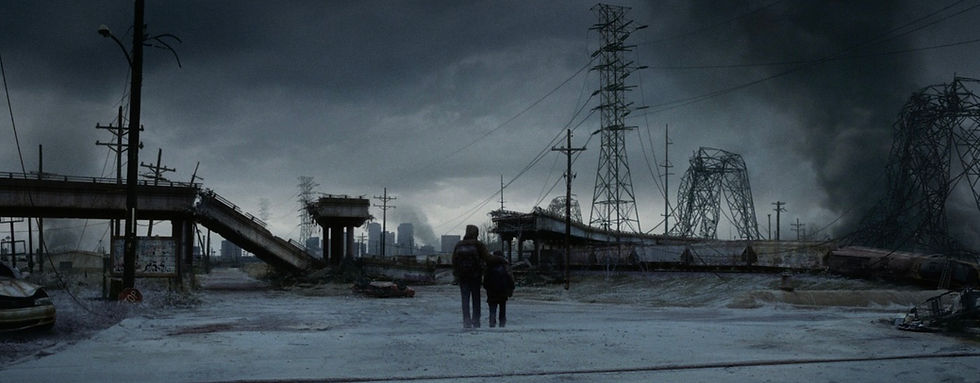
Apocalyptic dramas naturally lend themselves to starkness, but never have I seen a movie quite so visually grim as The Road. I'm not even sure it's close. Whole forests of trees have been reduced to ugly, naked stumps of wood, overpasses have been dropped unceremoniously onto highways below to slow down the few remaining survivors, and a murky and gray sky hangs over it all like a constant reminder that all is not well in the world; an unspecified disaster has laid waste to what I can only assume is the whole planet, and now a man and his boy are but two pinpricks of light in the suffocating darkness. This world is so gray, it sometimes seems as if the two of them are wandering across an extraterrestrial world. Still, Hillcoat reminds us that we as humans are worse than any malicious alien species we could dream of. One scene in this movie features victims of one less-than-benevolent survivor society hidden in a basement, and the unmistakable atrocities committed against these poor souls chilled me to the bone in a way a movie hasn't been able to in a long time. Contrasting this brutality is the steadfast father and his love for his son, a familiar but unmistakably human element that is more or less the entire point of The Road.
The man and his son are trying to make their way to the sea, but besides this relatively pie-in-the-sky motive, my biggest gripe with this movie is its lack of an aggressive-enough driving force. The simplicity of The Road is refreshing at times, but it has trouble sustaining its relatively humble vision as its story gets bigger. This father-son duo carries the fire, but it's sometimes hard to tell how or even where. I understand that much of this vagueness is by design, but the aspirations of this movie are modest, and such is the result. Still, I'd be lying if I said this simplicity doesn't add to the experience in any meaningful way, though it detracts from the sharpness of the story. The Road doesn't feel quite like any movie I've ever seen before, and its simple nature gives it a grounded, believable element. This is less of a story, more of a day in the life of a man and his boy surviving the apocalypse, which is likely the point. This movie is a simple one, and doesn't make too many major missteps because of it, even if it's limited either by its source material or unwillingness to take creative chances, not necessarily with what it includes in its story, but how it includes it.
Through the good and the bad, The Road has one not-so-secret weapon: its heartwarming father-son dynamic. If most everyone else out there is representative of the worst of humanity, then these two are, as the father puts it, carrying the fire. This movie works because it's impossible not to want the two of them to succeed. Even if they're not the most profound or complex duo of all time, you'd have to have been raised in a dungeon by a family of killers not to empathize with their goal. Its aspirations are not philosophically lofty. Its story is not deftly woven together like some intricate tapestry. And yet, The Road largely succeeds because of its willingness to interact with our humanity, good and bad, on the most fundamental of levels. The darkness in this story is suffocating, and first McCarthy, then Hillcoat understood that the light needed to be that much brighter.
The Road is a simple story told very well, a movie that prioritizes the viewer's experience over depth. Surprisingly enough, its most innovative aspect is a small treat hidden in the end credits that is quite unlike anything I've experienced before, a subtle but startling addition that admittedly took my breath away. Nevertheless, that's not to say that the story this movie tells is ineffective or that you'll have to wait for the end credits for some intellectual gratification. This movie is a testament to both the heights of the human spirit and the depths of human depravity, a story about carrying a resilient light through a suffocating darkness; you'll feel both in equal measure. The Road is nothing if not sincere, and it's a sincerity that can even be painful to watch sometimes, in a good way. It might be simplistic, but I can't say I've ever seen a film so overwhelmingly bleak as this one. Ironically enough, when it decides to be something other than gray, it shines like a ruby hidden under the rubble of a house. Because even if it's gray to a fault, The Road has a heart of gold buried underneath the ash.
The Road - 7/10
Psalm 103:13-18


Comments