


Joker: Everyone Was Wrong About This Film
- Luke Johansen
- Oct 14, 2023
- 10 min read

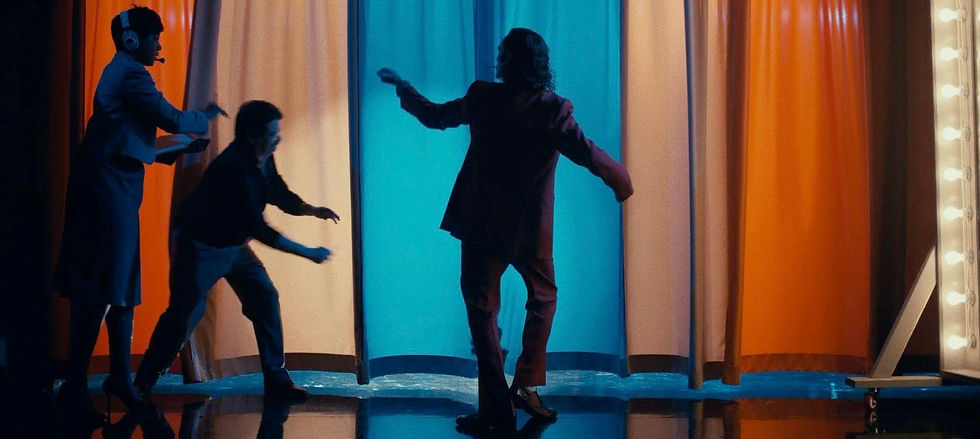
Recently, I finally got the opportunity to watch Todd Phillips's incredibly polarizing take on the clown prince of crime, simply titled "Joker." I had heard it all in regards to this film. Some treated it as a benchmark of cinema, while others dismissed it as hate-mongering rubbish. I had heard it described as everything from, and I quote, "movie of the year" to "pernicious garbage." Obviously, those are two very different statements. No one seemed to be able to stay civil in a conversation about it. It was a paragon of starting arguments online. And so, to be honest, I was kind of excited to watch it. I wanted to feel the rush of watching what had been propped up to me as an insanely counter-cultural cinematic experience. And as for my thoughts after the film? Well, like most movies that split critics and audiences down the middle, "Joker" is neither as good as its promoters proclaim it to be nor as bad as its detractors want it to be. I think that both parties raise some very good points about this film, because there are some things this film does really well, and some other things it doesn't do as well. Just a couple of warnings up front: if you're going into this article hoping that I'm going to back up and affirm your opinion on the film, whatever your opinion may be, you'll probably find yourself a tad disappointed. As for the second warning, this article is going to contain spoilers for "Joker" as well as discussions of some rather mature subject matter. So, if you're sensitive to that kind of thing, it's time to jump ship for you. And here...we...
...go.
To throw out a pretty brief synopsis, "Joker" follows a mentally ill and lonely man named Arthur Fleck as a series of unfortunate, tragic, and violent events put him on the path to becoming the legendary clown prince of crime himself. Now, onwards.
It's pretty commonly accepted that Heath Ledger presented the strongest performance as The Joker in Christopher Nolan's marvelous 2008 crime epic "The Dark Knight." And I can't bring myself to disagree with that sentiment because, well, it's accurate. However, Joaquin Phoenix's portrayal of a very different, more vulnerable Joker in this film is nothing short of spectacular. Even if it may not paint the most realistic picture of mental illness, those trying to detract from the film by pointing this out are, for lack of a better word, reaching for a dumb argument. Because what exactly does this argument say about the quality of either the characters or the film? Nothing. That's what it says. Phoenix brings an incredible amount of devotion, gravitas, vulnerability, psychopathy, delusion, and grandeur to the role of the Joker. That Oscar he won for "Best Actor" was well-deserved, which isn't something I can often say about awards shows nowadays. He was positively mesmerizing to watch. Never had I ever thought that this amount of laughter from a character could make me so sad. You know, maybe that tragedy = comedy thing the film kept talking about had some merit to it. The supporting cast was also excellent. Zazie Beets nailed the role of Sophie and provided the perfect foil to Arthur's character, and Robert De Niro's portrayal of Franklin Murray, though brief, was electrifying. However, what I like most about "Joker" is that this is Arthur's movie. Every other character in the film revolves around him, and this was refreshing in a world where superhero films tend to prioritize large-scale spectacle over small-scale character development, the latter of which is far more intellectually and emotionally satisfying. "Joker" understands this, and its small budget likely actually helped the film in this case, forcing it to be a small-scale character study that has its priorities in the correct place. In short, this film is about what happens to its characters rather than what happens around them.
However, I did notice one annoying flaw at the beginning of the film that popped up several times throughout the plot. When Arthur was getting his sign stolen along with a side of a sidewalk beat-down, the film took this way too seriously. In short, "Joker" suffers from an elevated sense of self-importance, a similar idea to what I pointed out in my review of "Prisoners." It thinks it's a bit deeper philosophically and psychologically than it actually is. And that's not to say that it doesn't introduce interesting plot points built around some interesting philosophical and psychological concepts. That's just to say that the film thinks it's a little bit more profound than it really is. While this issue does tend to fix itself a little bit as the film progresses, it is overwhelmingly pervasive at the beginning of the movie. Essentially, if Heath Ledger's Joker had met Arthur Fleck, the first question he asked him would probably have been, "Why so serious?" On top of that issue, the film does tend to reach for the "shock" card from time to time, most notably when Arthur kills a co-worker named Randall in a sequence that puts the violence in Tarantino films to shame. Now, there are some moments where the film genuinely surprises you, and I do appreciate those. I just wish that this film would either mix the shock with a manner of surprise or leave the shock card at home altogether.
I'm going to establish a pattern for this article. I'm going to point out one thing the film does well and then point out one area where it falls short. And because I just pointed out a flaw, I now need to recognize that the art style, atmosphere, and score of the film are absolutely incredible. No, they're beyond incredible. They are simply arresting. I had never seen or heard a live-action film quite like this before, and I don't imagine I ever will again. Imagine with me, for just a second, that "The French Connection" was set around a circus. That's essentially the world of "Joker," and it's absolutely magnificent to look at. And to think that they accomplished this atmosphere with a fraction of the budget of MCU projects. Take notes, Marvel. Hildur Guðnadóttir's score (don't ask me to pronounce her name) is marvelous. It's beautiful, booming, intimate, tragic, and unique. Some of the other non-OST songs that populate the world, especially Frank Sinatra's "That's Life," which pops up a number of times throughout the film, add an air of authenticity to the film as well. Only two other live-action Marvel and DC entries, "Logan" and "The Batman," rival this film for sheer atmosphere, and that is high praise from a man like me who appreciates high-quality and practical production design that lends believability to a movie. We probably won't see many more films that look visually like "Joker" in our lifetimes, and we need to appreciate films like it that want to ensnare you in a world that the filmmakers obviously care so much about.
Now, that said, another thing that bothered me about "Joker" was its tendency to be somewhat derivative. Essentially, at least from a narrative point of view, this film is pretty much "Taxi Driver." Both films are about a descent into murderous madness in a city full of people who don't really appreciate our main player. And in a much, much more specific vein, both films portray imagined relationships with real women. I was still surprised when it occurred to me that Arthur had completely imagined a romantic relationship with his neighbor, Sophie, but then I thought to myself, "Where have I seen this before?" And while the approaches are, admittedly, different from each other, the similarities and ideas behind them are too striking to ignore. When the women in their lives walk out on them, that is the final nail in the coffin for Arthur as well as for Travis, the main character of "Taxi Driver." I ultimately wish that "Joker" had strayed a little bit more from the films that inspired it. There is nothing wrong with borrowing inspiration from other movies. Pretty much every movie ever made has borrowed inspiration from films that came before. However, there is a difference between borrowing ideas and aesthetics and borrowing incredibly narrow and specific plot points. One is acceptable, and the other feels lazy.
Now, on a more positive note, when this film hits its notes correctly, it can be incredibly powerful and complex without feeling overly complicated. This harkens back to the film's strong characterization. I grew to care about these characters, and I imagine that you probably will as well. It's hard to not sympathize to some degree with Arthur's predicament. At the beginning of the film, he's a strange but genuinely compassionate character who only wants the best for himself and others. He's an underdog, shunned by a society intent on kicking him while he's down. I cared about Arthur, and this added layers upon layers to his descent into madness. It was like watching someone I'd known my whole life, someone like that odd friend that you knew was well-intentioned, snap under the weight of this world. "Joker," above everything else, is at it's heart a tragedy. And you feel it. You feel the tragic weight of the world Arthur inhabits. It wasn't lost on me, and I'm pretty sure it won't be lost on you either. Unfortunately, the film sometimes takes this too far, and it's tragic tendencies can become heavy-handed, almost as if the movie needs Arthur to go insane because, if you really think about it, it does.
In the months before the release of "Joker," lots of different news publishers freaked out about how "Joker" was going to inspire disaffected, young white men to commit horrible acts of violence. However, once everything was said and done, it turned out that "Frozen 2," released around the same time, ended up inspiring more violence than "Joker" did. OK, that's something of a joke, but it's not entirely untrue. Interesting story, at that. Just go look up "Frozen 2 Theater Brawl." Now, it's interesting to me that the media fixated on this idea that "Joker" would inspire violence, because the movie ultimately walked a very fine line in what was nothing short of immaculate fashion, and that line was that it made you understand perfectly why Arthur becomes the way he is, and yet the film never tries to justify his actions. This is no small narrative feat, and I imagine it required immaculate attention to detail while writing and editing the film. I really couldn't blame Arthur for wanting to dismantle and tear down a system that had mistreated him for so long, but when the ashes had settled, I found myself feeling....sad. Not angry or scared, but sad that horrible situations had created an even worse man. I think the underlying message of the film would have to be "be kind to those around you. You never know who needs it the most." And frankly, I think that's a message worth celebrating, even if it was wrapped in an imperfect, violent, and sobering package.
On the downside, one problem I had with "Joker" was one specific point in the narrative of the film: the pacing and logic leading up to and following Arthur's killing of Murray Franklin live on his talk show, Live! With Murray Franklin. By and large, the plot of the film was relatively straightforward with some absolute strokes of genius laced here and there. However, the plot of the film speeds up unexpectedly and in what I would consider to be an unearned fashion following the killing of Murray. Suddenly, we're thrown into what's grown from some verbally fiery protests to a full-blown, city-wide riot just like that. Essentially, what we had on our hands was a sudden, un-led-up-to escalation in the plot of the film. And to add a little bit of insult to injury, before that, Arthur had killed his rude coworker Randall in cold blood, while another one of his colleagues, Gary, watched helplessly. Arthur ends up sparing Gary and letting him go because Gary had been kind to him. Wouldn't Gary have, I don't know, called the police after witnessing a murder? Maybe it's a little unfair to nitpick, but the bigger issue I'm trying to address here is the erratic pacing towards the end of the movie. There had to have been a better way to pace this portion of the narrative than what we got. Now given, the movie ends on a very high note with the implication of Arthur murdering his therapist at Arkham and then walking down the hallway leaving bloody footprints behind him, but everything that came right before happened way, way too quickly. The movie would have been prudent to add an extra 20 minutes or perhaps even another half-hour to the film to even out the pacing issues towards the end.
As for the aformentioned ending, it was absolutely incredible, and the many theories that abound as to whether or not any of what happened in the movie was even real only attest to that fact. By the end of the film, I found myself questioning every little thing that had happened. I even questioned if Arthur had even been on the Murray Franklin Show, or if he had just done something unusually dumb, gotten himself put in Arkham, and made up the whole plot of the movie in his head. And what I say next may sound strange, but stick with me here: the end of the movie was also really bad along with being absolutely incredible. I found myself asking whether or not the film would pick and ending and stick with it, or if it would just keep tacking scenes onto itself. I wish that the movie had ended on a more decisive note, although I do acknowledge that Arthur's personality does lend the plot of a film about him to some manner of indecisiveness, and that to accomplish this trick of making the audience question reality itself, having a weirdly-paced ending might have been a necessary evil.
Now, is "Joker" a good movie? Well, yes. Mostly. In short, it's ultimately a good movie with some annoying tendencies. Like I stated at the beginning of the article, it's neither the benchmark of modern cinema some prop it up to be, nor is it the violence-inciting trash heap others wish it was. In the end, "Joker" is a solid "B" effort. I liked the moral ambiguity in the film in regards to Arthur's actions as well as how it avoided glorifying some truly awful acts of violence. I also like how the film asks you whether or not it was all worth it, or if all of it was even real instead of simply telling you what to think about it. Frankly, that sounds like something Arthur would do, so if you think about it, the film that was narrated by him asks an implied question at it's end that is in line with his character and something his character would actually ask you. And in the end, I can't help but get the feeling that one reason some people dislike this movie so much is that it held a mirror up to society, and we hated our own reflection. "Joker" was a film about mental illness, and I ultimately don't understand why some people expected it to behave like it wasn't.
Joker - 7/10
Philippians 2:3-4


Comments